



In this article
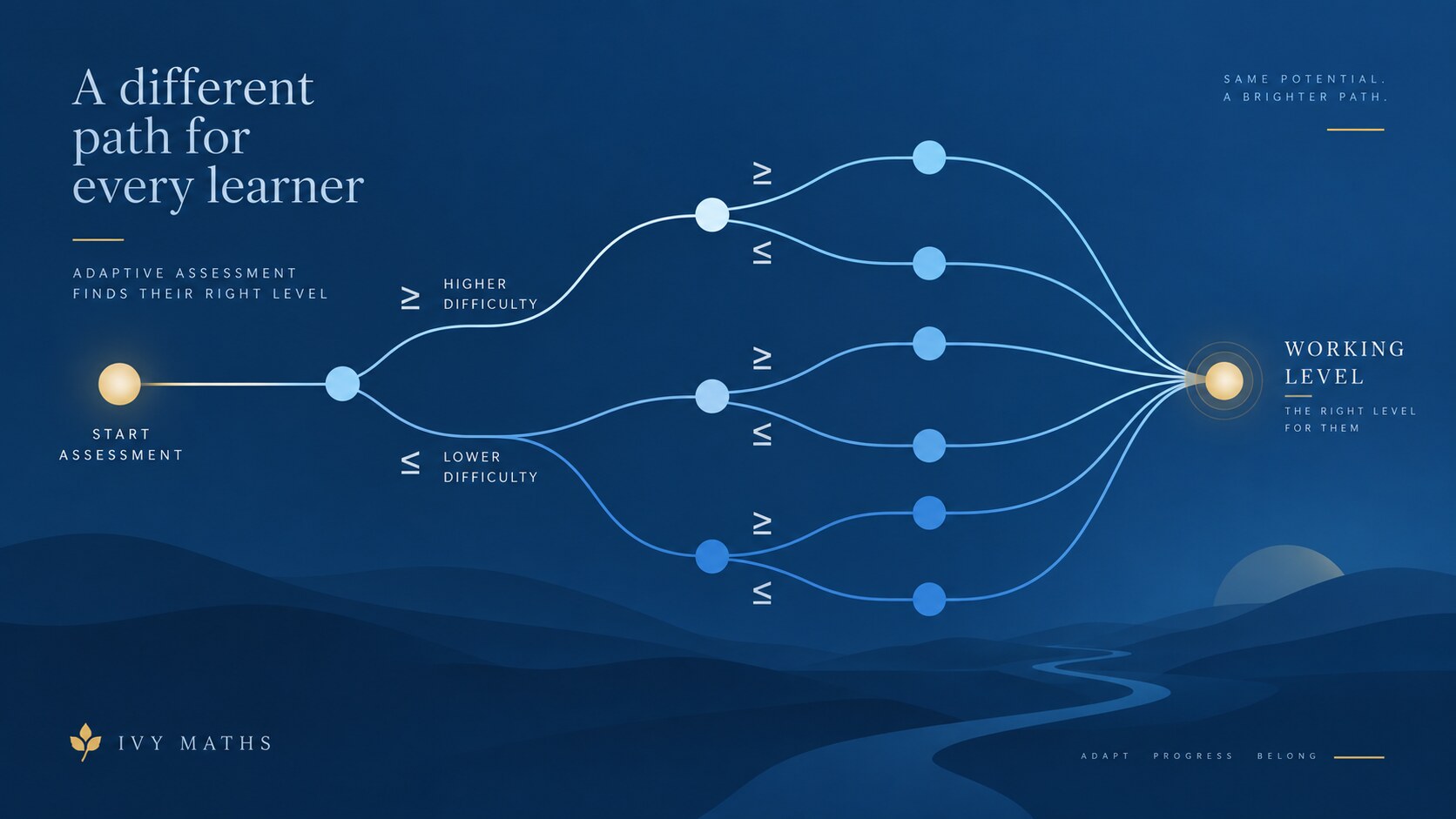
An adaptive maths assessment changes the questions it asks based on how the student is answering. A correct answer leads to a harder question, an incorrect one leads to an easier question, and the assessment continues until it has narrowed down the level at which the student is working reliably. Everyone sits a different set of questions, and the point of the exercise is to locate a working level rather than to produce a mark out of a fixed total.
A conventional test does the opposite. Every student answers the same questions, and the result is expressed as how many of that fixed set they got right.
1. How the Adjustment Works
The assessment holds a bank of questions, each with a known difficulty, calibrated by how large numbers of students have performed on it. It begins somewhere reasonable, usually near the expected level for the student’s year group, and then moves.
If the student answers correctly, the estimate of their level rises and the next question is drawn from higher up the bank. If they answer incorrectly, the estimate falls and the next question is drawn from lower down. Early questions move the estimate a long way, later ones fine-tune it. The assessment stops when the estimate is stable enough, which is why an adaptive test can often reach a confident conclusion in fewer questions than a fixed paper needs.
The consequence worth understanding is that a student is meant to get a meaningful proportion of questions wrong. An adaptive assessment where everything is answered correctly has not finished its job.
2. What It Shows That a Fixed Test Cannot
The main advantage is range. A fixed Year 8 paper contains Year 8 questions. If a Year 8 student’s real difficulty is with fractions from Year 5, the paper will register that they performed badly without being able to say where the floor actually is, because it never asks anything below Year 8.
An adaptive assessment keeps stepping down until the student starts answering correctly, so it reports something specific: not “struggling with Year 8 maths” but “working securely at around Year 6, insecure above that in number”. For a parent trying to work out where to start, that difference is the whole point.
Two secondary benefits follow. Adaptive assessments are usually shorter, because they do not spend time on questions that carry no information. And they tend to be less demoralising, because a student who is behind is not handed twenty questions they cannot attempt.
3. Where Adaptive Assessment Is the Wrong Tool
It is not a universal replacement, and it is worth being clear about the limits.
It does not tell you why an answer was wrong. An adaptive engine records right and wrong. Unless it is paired with reporting that identifies which skill each question tested, you get a level rather than a diagnosis. The reporting attached to the assessment matters as much as the adaptivity.
It needs a large, well-calibrated question bank. This is the difference between a genuine adaptive assessment and a quiz that branches. If a product simply gets harder when you answer correctly, without calibrated item difficulties behind it, the resulting level is not meaningful.
It is poor for checking whether this week’s teaching landed. If you want to know whether a child has understood the lesson on angles in parallel lines, ask them ten questions on angles in parallel lines. Adaptivity is for locating a level across a wide range, not for auditing a single topic.
It cannot see working. A student who reaches the right answer by an unreliable route registers as correct. Looking at written working remains necessary.
4. Choosing Between the Three Types
The three kinds of test answer different questions, and the table sets them side by side.
| Topic test | Fixed full paper | Adaptive assessment | |
|---|---|---|---|
| Everyone answers | Same questions | Same questions | Different questions |
| Range covered | One topic | One year or key stage | Spans several year groups |
| Best at | Checking recent teaching | Comparing against a standard | Finding the working level |
| Typical length | Short | Long | Short to moderate |
| Main weakness | Says nothing about retention | Floor and ceiling effects | Needs diagnostic reporting to be actionable |
5. Using Them Together
For most parents the honest answer is that these are complementary. A topic test after teaching, an adaptive assessment once or twice a year to check where the level actually sits, and a full paper when you want a result that is comparable to a standard.
Ivy Maths uses Full Assessments to locate working level across year groups and Module Assessments for topic-level checks, with results reported by strand in an Instant Report rather than as a single number.